Friday, October 29, 2010

The Toughest Nut?

One of the arguments Christians apologists like to trot out is that we have a system of morality that we can depend on, handed down from God himself in the Bible. Where atheists are "infants, tossed back and forth by the waves, and blown here and there by every wind of teaching and by the cunning and craftiness of men in their deceitful scheming" (Ep 4:14), we can look to the Bible for definitive pronouncements about everything needed for faith and practice. While the Bible is not clear about everything, it is clear about everything that's important.

It is this certainty that has inspired the martyrs over the centuries, and it is the basis on which those stand who believe that "thy kingdom come" will be fulfilled in some degree through the church before the return of Christ, as exemplified by this passage from an article handed me by a friend:

The gospel tells us that all enemies of Christ will be subdued before the Lord returns—with the one exception of death. That enemy will be destroyed by the Lord Himself. All the other enemies—famine, disease, pestilence, war—will be destroyed through the agency of the faithful proclamation of the gospel, adorned by the Church living it out. (Douglas Wilson)

Unfortunately, either war is not an important subject, unclearly addressed as it is by the Bible, or the Bible does not address all important subjects clearly:

But we have good reason for believing that war will be one of the toughest nuts to crack. It well may be that it is the next to last enemy to be destroyed.

I suspect my friend directed me to Brother Doug's article because it contains this:

Winston Churchill defined a fanatic as one who can’t change his mind and won’t change the subject. The ideologue is similar—he demands submission from everyone to the dictates of the abstraction that holds his loyalty by the back of the neck. This is why, without any sense of irony, the advocate of pacifism can find himself arguing, in the most bloodthirsty way, for the engines of war to get warmed up.

I consider myself more a wimp than a pacifist, but anyone who opposes the present wars is tossed in the pacifist pile, so I guess that's why I was given the article. And since the war is a topic that I find myself addressing often and my opinions are not likely to change soon, I'll concede that I'm a fanatic. I'm not sure "do for your neighbor what you would have him do for you" and "what's yours is yours, what's mine is mine; keep your hands to yourself and tell the truth, and it doesn't matter who you are, we ought to be able to get along" is an ideology, but my friend and Brother Doug might think so. So if I'm a fanatical pacifist ideologue, make of it what you will.

The article's conclusion is reasonable, or at least I think I can agree with it, even the first clause:

I am no pacifist, and so I believe that there are wars that are just in principle, and in which Christians might participate with a clean conscience. I hold this position as one who believes that every just war ought to be aimed, in principle, at the glorious elimination of war that the prophets have wonderfully anticipated for us. If we hold our convictions about war in this way, refusing the ideological lure, we may not see wars abolished as quickly as we might like. But if we reject ideology, we will at least not be breeding additional and unnecessary wars in the meantime.

Now war is an abstraction: while there are no doubt some who find rapacity more rewarding after a good hard battle where even their own side takes casualties, most prefer to show up with overwhelming force, skip the battle, and take the women and the loot. You don't need the Bible to convince most people that war in the abstract isn't a good thing.

This war, however, is no abstraction. It has visible, tangible, measurable effects on millions of people. If nothing else, the money we send to Washington to keep the army over there is money we're not sending to missionaries, who are feeling the pincers of inflation and reduced giving.

So I find rather scary a theme that runs through the article, as encapsulated in the penultimate paragraph:

As a Christian pastor and biblical constitutionalist, I opposed the war in Iraq on constitutional grounds. The president is not authorized by the Constitution to go to war with another sovereign nation and replace its government. Congress has the responsibility to declare war. This conviction of mine is a political opinion, one which I would never dream of invoking in the discipline of God’s people. And godlier men than I believe that the war is perfectly justified, both constitutionally and scripturally. I write this, not as a max nix [sic] relativist, but as someone who believes that the diamonds of some absolute truths are not lying on the surface of the ground. For those, we will have to dig some deep mines. But as the historian Christopher Dawson once put it, the Christian church lives in the light of eternity, so we can afford to be patient.

Christians living in the US can certainly afford to be patient: Uncle Sam isn't dropping bombs on us from unmanned aircraft (yet). Will Brother Doug be as patient when he's dodging bombs? And what will he be able to do about it then if he should decide that Christians shouldn't be part of the imperial army? More importantly, if he does decide that this war is wrong, what will he tell his sheep who have assumed so far that it is OK to be part of it?

Since the Bible apparently isn't clear about how we are to think about the war, let alone what we are to think of it, Brother Doug is left with the Constitution for guidance. But he admits that he can't agree with "godlier men" than he what the Constitution says, so even that's no help.

(Then there's the question of whether a document that is de facto being ignored can be appealed to at all. Worse, as Gary North and Lysander Spooner have written, the ratification of the Constitution was of questionable morality, and its nature as morally binding would be suspect even if it were lawfully and morally instituted.)

So, having eliminated all authoritative backing for any pronouncement he might make about the war, he is left with saying nothing and calling it patience. But I have a problem with the selective nature of his patience:

If an abortionist sought membership in our church, we would refuse him unless he repented. If a homosexual couple sought membership, we would refuse them. If a pornographer wanted to join, we would say no. But would we allow a conscientious objector in? Yes. Would we allow a colonel in the Marines to join? Absolutely. Does this mean that I believe “it is all relative” and that when it comes to issues of war and peace, each Christian can just choose for himself? No. But it is a recognition that the prophetic vision recognizes that when men come to “study war no more,” and the lion lies down with the lamb, and men turn their ingenuity to the task of making the finest plowshares out of the finest spears, we are then at the culmination of the gospel age. The elimination of war is not irrelevant to Christian worldview thinking, but is rather the capstone of that kind of thinking in history.

(Notice that Brother Doug is talking about church membership, not about attendance. He and I both, I think, desire passionately to offer the good news to abortionists, homosexuals, pornographers, conscientious objectors, and Marine colonels as much as to anyone else, and to love them as people no more self-interested and sinful and no less desirous of doing the right thing than we are.)

So the church can be definitive about the killing of the unborn, but not about killing those already born, about sexual sins, but not about the taking of innocent life on a massive scale. Brother Doug might be right, but what does that say about the authority of the Bible?

I'm no church historian, but I understand that in Tertullian's day one had to choose between being a Roman soldier and a church member:

The case is different, if the faith comes subsequent(ly) to any (who are) already occupied in military service, as (was, for instance, the case) with those whom John admitted to baptism, and with the most believing centurions whom Christ approves and whom Peter instructs: all the same, when faith has been accepted and signed, either the service must be left at once, as has been done by many, or else recourse must be had to all sorts of cavilling, lest anything be committed against God – (any, that is, of the things) which are not allowed (to Christians) outside the army, or lastly that which the faith of (Christian) civilians has fairly determined upon must be endured for God. For military service will not promise impunity for sins or immunity from martyrdom. The Christian is nowhere anything else (than a Christian).

When the need to choose disappeared I don't know, but surely it was gone by the time Constantine made Christianity the official religion of his empire: "Hot dog! Now we can really make disciples!"

Brother Doug describes himself as a "biblical constitutionalist" and his opposition as being on "constitutional grounds." I hope the label means he reads the Constitution through the lens of the Bible and not the other way around, but to say that his opposition is constitutional rather than biblical is breathtaking. Does the Bible not give him anything to say about this particular war?

"No, Mr. Quill Pig, it doesn't. And if you look in Romans 13, you'll see that the state has been given the power of the sword."

Commenting on Romans 13, the Westminster Confession says that the civil magistrate is bound to enforce "wholesome laws"; he is not free to act as he chooses. If, by Brother Doug's own admission, this particular war is unconstitutional, prosecuting it is a lawless act, and Christians are not to participate in lawless acts, because "all sin is lawlessness" (1 Jn 3:4). I think he would do well to call a meeting of his church elders, lay out his case, invite those "godlier men" than he to lay out their cases, and ask the elders to take a stand about the moral nature of this war, calling on his denominational leaders to follow suit. Again, we're not talking about the color of the carpet in the sanctuary or even whether a drum set should accompany the music team: we're talking about whether or not God is calling Christians to disrupt the lives of millions of people who are on their way to a Christless eternity.

My congregation and denomination have endorsed this war from the get-go without even so much as a discussion or an explanation. We pray more on Sunday mornings for the soldiers who fight for Uncle Sam than we do for our missionaries, and we send more money to Washington to support the war than we do to our missionaries. Yet the topic has never been discussed officially. It's as though we don't dare raise the subject lest the discussion become heated. My church claims to carefully avoid taking stands on political issues, but nothing is more political than war, and not to raise the issue is to side de facto with the warmakers and then to pretend as though which side the church is on is not important.

I'd rather be excommunicated by a church that decided—after deep, lengthy, and passionate discussion—that to oppose this war is tantamount to abetting the murder of Americans than to see God's people refuse to discuss the issue (Re 3:15).

Does the Bible not talk about matters of life and death to millions of people? If it doesn't, can one not be forgiven for asking, "God is good, but what's he good for"? I know atheists who have no desire to hear the gospel precisely because Christians who will wax tearful over the evils of intrauterine devices can't bring themselves to call bombing women and children in a country with which we are supposedly allied evil. They would answer in Stalin's famous words: "When one person dies, it's a tragedy. When a million people die, it's a statistic." And we know Jesus doesn't care about statistics.

Saturday, October 23, 2010

Erwin Lutzer's Is God on America's Side?

Erwin W. Lutzer. Is God on America's Side? Chicago: Moody Publishers, 2008. 103 pages.

Most Christians in the US seem unable to separate the cross of Christ from the "American" flag. I would suspect that most Muslims can't either. For the former, the identification of the Christian God and their native land is a source of pride and joy. The latter, especially those who have lost family members, their health, or their homes to US imperialism, could be forgiven for deciding that if the Christian God is like Uncle Sam, no decent person would be a Christian. Unfortunately, it's even worse than that: they cut themselves off from the God whose forgiveness they need if they are to have eternal life because they identify that God with Uncle Sam's depredations.

So this book by Erwin Lutzer, pastor of Moody Church in Chicago, a bastion of respectable US evangelicalism, is a must-read for Christians who consider themselves patriotic Americans. While I have predictable quibbles with Is God on America's Side?—the societal sins he calls Christians to fight are gambling and prostitution, but imperialism is never mentioned—his message is just what the doctor ordered for his audience, mainstream evangelicals. Once we get evangelicals to question "American exceptionalism," the idea that the US is somehow God's chosen nation in a sense that Finland or Papua New Guinea could never be, they might be open to questioning the morality of Uncle Sam's out-of-bounds actions that they currently accept.

Lutzer begins by enumerating and discussing seven biblical principles:

God can both bless and curse a nation.
God judges nations based on the amount of light and opportunity they are given.
God sometimes uses exceedingly evil nations to judge those that are less evil.
When God judges a nation, the righteous suffer with the wicked.
God's judgments take various forms.
In judgment, God's target is often His people, not just the pagans among them.
God sometimes reverses intended judgments.

He then turns the title's question on its head by quoting Abraham Lincoln, "America's most admired president": "The important question is whether I am on God's side, for God is always right." (I quibble over the invocation of the president who was Hitler's favorite precisely because of his racism and imperialism, but again, invoking him would soften Lutzer's audience's defenses against the book's main message.) From there he discusses at length the crucial (pun intended) difference between building a political entity and building the kingdom of God.

He expresses this difference aptly: "Our job is not to save America but to save Americans by living the Gospel." Our nation is literally going to hell—read the obituaries and see where most of those named are headed—and its military is literally blowing women and children to hell, claiming such is necessary for its defense. Lutzer proposes that the church can survive and even thrive under adverse conditions; our job as Christians is to be faithful to God, working for justice and showing mercy and compassion.

So where would he have us go from here?

First, we must choose the right battle.

Where a general who loses on the battlefield can only give good advice about how to cope with the new situation, we need to be dispensers of the good news of Christ's victory over our enemies: the world (including the messianic state—that's me, not Lutzer), the flesh, and the devil.

Second, we must use the right weapons. [Yes, Moody's copyeditor should have checked to see that italics in this list were used consistently.]

The weapons he names are "helpless dependence on God's Word" and "the integrity of our lifestyle." We can never get enough Bible teaching, either on our own or from those whom God has called to study it. I am convicted of looking down on my neoconservative brethren for eschewing Bible reading for the teachings of the Mormon Glenn Beck and Fox News, the neoconservative arm of Fox porn, while I am myself not able to get enough of atheists like Stefan Molyneux and Latin Rite Catholics like Thomas Woods. More convicting still, the inconvenient biblical truth Lutzer discusses at length is that Jesus calls us not only to suffer but to suffer specifically for his name's sake.
Lutzer pulls no punches: he fully expects Christians to become a persecuted minority, but he makes it plain that we are not to have the "poor me" attitude that goes along with it: we are to rejoice that we are being counted worthy to suffer for Jesus' name and work hard depite our suffering to win people to Christ. (If I can't abide people lolligagging in the left lane on the expressway, how will I tolerate being caged or waterboarded?)

That is, when it is essentially illegal to be a Christian, we are to obey God rather than men. I don't know that Lutzer would translate that into breaking the fugitive slave laws, let alone breaking today's drug laws to provide marijuana to people dying of cancer so they don't have to endure either the excruciating pain of the disease or the expense, nausea, and impaired mental state that go along with morphine use—and if he did, saying so might alienate his audience—but he's at least giving the lie to the idea that the cross and Old Glory are inseperable, and that's a giant step in today's US evangelicalism.

The final chapter is titled "Winning Even When We Lose." Whether Uncle Sam survives or not, the church of Jesus Christ will keep going. She grows under adversity, and she is growing fastest in the nations that persecute her and in other places we comfortable saints wouldn't voluntarily live. And her best days in North America may still be ahead of us; but if they are, they will be accompanied by severe persecution.

Lutzer points out that the churches Jesus addressed in the seven letters of Revelation have all disappeared, as has the Christianesque culture of North Africa and the Europe of the Reformation. The same thing can happen here. And the likelihood of it happening here increases as Christians claim that God is on America's side rather than asking if they and their society are on God's side. May his warning be heard by many.

Friday, October 22, 2010

"Would You Go All the Way?"

Would you go all the way for the USA?
Would you go all the way for the USO?
Would you go all the way for the USA?
Lift up your dress if the answer is no.

Frank Zappa's raunchy lyrics from the 1960s aren't so "far out, man," anymore. Now if you want to fly, you've got to take it all off for the TSA. Some prudes and geezers object, of course, but we can always expect some people to resist progress.

It's also usually true that if people knew what would happen at the end of the road, they might have been less complacent during the early stages of the journey. Honorable men like Dietrich Bonhoeffer and Martin Niemoeller supported Hitler initially, only to find that their trust had been misplaced; Bonhoeffer's repentance cost him his life.

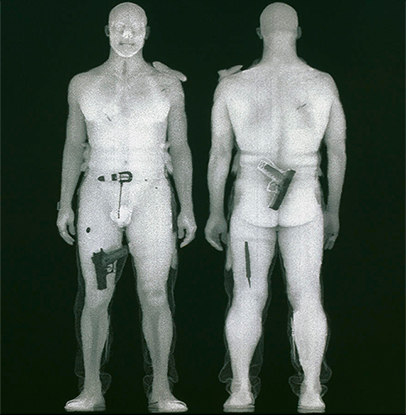
If people had known how graphic the images from the virtual strip-search scanners would be, they might have resisted early on. I certainly wanted to know what was happening, but during the run-up, the only pictures available were this, which looks pretty innocuous. Even this and this aren't so bad (especially when your attention is drawn to the hidden weapons). One could understandably ask, what's the big deal?

But of course, as one can expect from a police state, they weren't giving us the real picture, and only after the TSA had begun installing the devices at airports was it possible know for sure what we would look like "on camera." Leave it to disgruntled pilots, who probably thought they were going to be exempt from the indignities, to squeal once their ox got gored. Check it out here. And while the resolution isn't magazine quality and the image is black and white, one can expect the resolution to improve over time and color to be introduced, "for security purposes only," of course.

Do you think people who don't want such pictures taken of them are unreasonable?

My boss, who is a Jewish atheist, doesn't mind the situation. He doesn't even mind having his wife go through. (She's a looker, so maybe it's his way of boasting.) He says the machines are faster than the old scanners (how having to stop and pose is faster than walking through a metal detector is beyond me), and besides, the guys manning the screens "get inured" to what they see.

I see his point: I found out in my early teens that I lost interest in my friend's physician father's four-foot stack of Playboy magazines about the third time through, though that was before they could publish full frontal nudity; otherwise I would likely have needed another pass or two.

The inurement argument doesn't hold water. I read an article by a gynecologist in Reader's Digest decades ago, and he stated matter-of-factly that he isn't above noting (in ways only he can read?) that a certain patient has "nice breasts." I've asked two physician friends how they dealt with seeing naked women, and they admitted that they don't cease to be guys. As I said, my friend's father, who was a physician, kept a stack of Playboys, and indeed the first Playboy I ever saw belonged to my physician uncle. We lived in a village in Papua New Guinea for almost two decades, and I was never unaware of what women were and weren't wearing shirts, and yes, I had my preferences. Most unmarried women with developed breasts would wear shirts until they delivered their first baby, probably because they were aware that young, firm breasts can distract males from what's important in life. You can't tell me the occasional looker wouldn't be a perk to the guy watching the screens.

What does all this have to do with Jesus? I frankly don't know. I could go on about how the rise of the messianic state in the US has been accompanied by a decline in morals, but this post is long enough already.

But I do know that any Christian who hasn't spoken out against strip-search scanners but disparages nude beaches will immediately lose his credibility with me.

Tuesday, October 19, 2010

Paul White, Frank Peretti, and George Washington

I learned a lot from the books I read to my kids when they were young. One that hit close to home was a comic adaptation of a story by Paul White, who apparently was a missionary in Africa. We had other comics of his stories, all set in Africa, but this one always made me uneasy.

It was about a young man who found a leopard cub and decided it would make a neat pet. Some old geezer in the fillage told him he should kill the cub, but the cub was cute and playful, and the young man was sure he could keep it under control. The old man left the young man with this warning: "You have to make sure that that that leopard never smells blood, because once he does, he will only be satisfied with fresh meat."

You've guessed the rest. The young man gets a small cut while playing with the leopard—How could he have expected things to turn out otherwise?—and the leopard smells the blood and kills the young man and others.

Even I could see what the author was getting at: I'm not above indulging in a little questionable behavior that I think I've got under control. And when the leopard smells the blood, having to admit that I should have known better–ha! did know better—is a living death.

Reading that book to my kids was about a weekly experience. Another story that has stayed with me, even though I only read it once, was Frank Peretti's The Oath. The theme was the same as the comic, except this time the young man was a modern village in the mountains of the Pacific Northwest, and the leopard was an invisible dragon. Here a whole community had adopted this cute little dragon, but the more they loved it and fed it, the bigger it grew, the bigger its appetite became, and the nastier its reactions became when gratification was delayed. The dragon was eventually slain, but not before a lot of innocent people died.

And, of course, there's the Veggie Tale about Junior Asparagus and the giant fib, which turned into a monster that almost destroyed the town.

Why do we need so many stories with the same theme? I'd say it's because we don't learn. We all want to be an exception to that rule (except me, of course).

There once was a people called Israel who had a special relationship with God. For reasons of his own, God gave them a rich and fertile land to live in. Little by little the Israelites started cutting theological and moral corners. Paul White and Frank Peretti would no doubt say they had started nursing beasts as pets, but the pets grew up and became masters. Before long things were so bad that they decided they needed something God warned them against: "a king like all the other nations have." After all, this king would be "the anointed of the Lord," so how could that be bad?

Well, it was bad. All but one of those kings shed innocent blood, and the problem the Israelites had asked for a king to solve, utter defeat at the hands of their enemies, came anyway. How could things have gone differently?

You know what's coming, right? The newly independent colonists decided that the confederation of small, sovereign, independent states they had pledged their sacred honor to fight for wasn't good enough: they needed a stronger central government. (Or at least that's the story told by the "Federalist" victors.) Yes, a central government, with only those powers "delegated" to it by the states, that's the ticket! Of course, that federal government would have the power to determine whether which powers had been delegated, but what's the harm in that?

As Elmer Peterson has said, "A democracy cannot exist as a permanent form of government. It can only exist until the majority discovers it can vote itself largess out of the public treasury. After that, the majority always votes for the candidate promising the most benefits with the result the democracy collapses because of the loose fiscal policy ensuing, always to be followed by a dictatorship, then a monarchy."

The more power and privilege government offers to its agents, the more people who desire power and privilege will seek to work for the government, and the more powerful and expensive it will become. The leopard will grow up, and eventually he'll smell blood. It's best to kill the beast when he's small.

George Washington was a Federalist, part of the scam that now afflicts us as badly as anything King George ever wrought on the colonies. But he could talk convincingly, and here's a pearl we anti-Federalists wish he had taken to heart: "Government is not reason; it is not eloquent; it is force. Like fire, it is a dangerous servant and a fearful master."

Do we want this or that government to master us, or are we willing to settle only for the easy and light yoke of the Spirit of God?

Thursday, October 14, 2010

Response to a Correspondent

A friend writes:

Take away a system of force that punishes wickedness and wickedness will increase.
Men will do what is right in their own eyes. In a context of great evil God instituted the death penalty for murder. That institution was a civil action against private murdering citizens. If Henry murders the 7/11 cashier for some spending money, we are not going to ask [mutual friends] to stop over with a bag of stones for a neighborhood stoning. We are calling the cops, who will arrest you and stick you in a holding cage until we have a speedy trial with twelve good men. Then we are going to execute you properly with something other than stones.
Of course as a post-millennialist who believes in the power of God to save, we will also preach the gospel alongside of having the sword of the state to punish the wicked. Salt and light are part of a well ordered cosmos. So is a State with servants who are ministers of God. If Paul called first century Christians to submit to a pre-Christian, Non-biblical State, why do you keep imagining a stateless society when we live in a world that is way better as far as the presence of Christians in American society? Some of these Christians are good people who want to see government held accountable. Why not work to call the State to repentance ? Is the State beyond the power of redemption? I thought the church was tasked with calling all to repentance including Caesar.

My response:

Thanks for writing.

Given a choice between being shot by a firing squad and stoned, I think I’d rather be shot. Hanging and the electric chair might be worse than stoning. Anyway, I like to think that I’ve got better reasons for not killing the 7-11 cashier than fear of execution. Unfortunately, as I said in a recent post, the state might someday decide (in a moment of utter paranoia) that the Quill Pig Chronicles give “material support” to terrorists and execute its version of justice on me. If they just shot me, that wouldn’t be so bad. Unfortunately, they might decide I’m of more value to them alive than dead, and that would be tough to go through, even if they didn’t waterboard me. . . . .

The church is indeed tasked to call all to repentance, including Caesar. but what incentive does the state have to repent? How can an abstraction repent? What incentives do state agents have to repent?

"We live in a world that is way better as far as the presence of Christians in American society," do we? I started this blog because I think US conservative Christians are no longer salt and light. They are as zealous to defend their place on the tax-subsidized nipple as atheist liberals, and at least as prone to busybodyness and callous to wanton violence. Ask them how they defend their libertinism (see below) and they'll go straight to Romans 13. As you know, one has to read between the lines considerably before one comes up with even the Westminster Confession's take on Romans 13. Maybe when I get to heaven God will say, "I agreed more with Ron Paul and [my correspondent] than with you; anarchy would never work," but I would need a lot of help getting my mind around it. Meanwhile, I try to be a good neighbor as best I understand the Bible's take on that, and it seems to me an easy way to do that is not to act like I'm government agent.

By ascribing legitimacy to the state, you are removing at least one check on its wickedness, and its wickedness has increased in every situation. Read Colson’s book if you don’t believe my blog post that he chronicles in great detail (considering the size of his book) how this happened. Where he and I disagree is that he somehow thinks that that increase in wickedness was not inevitable given the nature of the state and given human nature.

Statism is indeed libertinism. When the FDA approves a drug that ends up damaging people, no bureaucrats lose their jobs, whereas in a private property system, the endorsing agency would be out of business immediately (remember Chi-Chi’s?). When the drug cops break down the wrong door, shoot the family dog, and make the homeowners get out of bed naked and stand around while the room is searched, said homeowners will be lucky to get a verbal apology; nobody will lose their job, and they'll still be stuck with the repair bill for the door. If that isn't libertinism, I don't know what is.

Jesus said that he who is faithful in little will be given charge over much. The state—at least the one we live under—can’t even be trusted to treat biblically innocent pot growers justly (I forgot: you don't think pot growers are innocent; OK, how about ghetto girls who braid hair or out-of-work carpenters who ply their trades without licenses?), and it certainly doesn’t treat either thieves or their victims justly. What makes you think it would treat murderers justly?

I’m surprised that a man who spends as much time in the Bible as you do would prefer to begin with the death penalty and work down and not with, say, embezzlement and work up (smaller to larger); that you prefer a top-down, coercive system when Romans 12:1-2 seems to indicate that God works from the inside out and the Mosaic system (apart from the giving of the law itself, for obvious reasons) from the bottom up. (Where the Catholics seem to think that the saints have God’s ear in a way that mere mundanes don’t, Paul asked the nobodies to pray for him, like he, The Apostle to the Gentiles, needed their prayers more than they needed his, though he did indeed pray for them.)

Men will indeed do what is right in their own eyes; furthermore, they will do what they think is to their advantage. When Jesus told us that there was no profit in gaining the world and losing our souls, he was acknowledging that people go for the bottom line, but he was saying that the bottom line is further down than we think it is.

The refrain of the book of Judges is indeed that people do what is right in their own eyes. Like the people of those days, you think that the solution is a king—though a godly king, like that described in Dt 17. Forgive me for repeating myself: the job of king was too big for a man who was head and shoulders over everyone else in Israel, for a man after God’s own heart, and for the wisest man who ever lived. (So who besides Jesus can ever fill the bill? How is Jesus present and ruling today? Isn't it mostly in the hearts of those who obey him?) Israel got his king, and he fell to his enemies for exactly the same reasons he fell to his enemies in the book of Judges. The problem was not the lack of a state; it was the lack of devotion to God.

There are only two religions in the world: God (the grace of Christ) and power (mammon, Baal, Molech, Allah, the Force, democracy). When George Washington said that government is force, he was putting it in the second category. And he would know, having exercised it as such. Thomas Paine said that government was a necessary evil, but as an atheist he would have no trouble saying that evil was necessary. Romans 6 forbids me to say that.

We live in an age when people who call themselves Americans almost literally worship at least one politician and certainly ascribe godlike powers to the state. How can we call people to faith in God when we ascribe legitimacy to his biggest rival? That evil needs to be opposed, sometimes with force, is not in question: you read the article I recommended to you, right? The author is not opposed to the use of force in certain situations. The question is, under what circumstances is it just? How does the line get drawn? What reason do we have to suppose that an irresistible state will draw that line more justly than an egalitarian contract system?

Note the question marks. Your questions are worth answering, so I'm grateful for the time you have taken. But your assertions leave me with questions, which you are welcome to answer; or ask more questions, if you prefer. Thank you again for writing.

Saturday, October 9, 2010

Charles Colson's Justice that Restores

Wise people don't take Charles Colson lightly. He became one of the most powerful people in the world during the Nixon years because he is intelligent, articulate, and sincere. While he is indeed a convicted criminal, he went to jail because of bad decisions sincerely made, and since his release he has shown that his repentance during his prison years was sincere; I would guess that he has spent at least as much time in prison as a free man as he did as a prisoner, and he has done so to spread the gospel. His Justice That Restores is a thin volume, but it's a small bowl of very hearty soup.

Colson and I share the belief that the criminal "justice" system is as fertile ground as there can be for sowing the seeds of the gospel. Crime hurts its victims, of course, and our system, in which victims have literally no chance for compensation, is simply barbaric. It also, at best, leaves perpetrators of crime in their twisted moral and spiritual state; in some cases it twists them even further. So far, so good. But this additional twisting is done by policies based on presuppositions that Colson and most evangelicals share with the system; I will suggest here that they are not biblical.

Colson's audience for this book seems to be nonbelievers: he doesn't quote the Bible until page 46, and he carefully avoids religious jargon. So effective was his packaging that early on I found myself rolling my eyes and expecting another "Christian" argument based on "natural law" rather than the Bible. But he was arguing deductively, describing first what doesn't work, then what is needed, and finally how the Bible prescribes a system that meets that need, first for individuals through the gospel and then for society through restorative justice, which he defines as

one that holds individuals responsible for their actions (that is, fallen individuals have a moral duty) under an objective rule of law (which we believe is rooted in revelation) but always in the context of community and always with the chance of transformation of the individual and the healing of fractured relationships and of the moral order. (p. 115)

The first part of the book is a litany of failed state-based solutions that offers at least prima facie evidence that the more the state is involved in the process, the worse the result is. He follows the evolution of criminal justice theory from the days of common law (not, unfortunately, biblical law), in which crime was considered offense against individuals, to today's unjust situation in which crime is almost exclusively thought of as transgression against the state. He also traces the erosion of belief in the authority of the Bible, then of belief in natural law (by which he specifically means the laws the apostle Paul says are "written on the heart" [Ro 1]), and finally of belief in the existence of absolute truth in any form. Today expediency alone limits political (and sometimes raw) power: both crime and the state's response are whatever those in power determine they should be. Again, so far, so good.

The problem comes with his proposed solutions:

The remedy for this crisis goes far beyond building more prisons. (p. 10)

A solution that goes beond something generally includes it. So his proposed solution involves building more prisons even though the US already incarcerates more people and a higher percentage of the poplulation than any other nation. If he is truly speaking for God here, US citizens, far from being the last great hope for the human race, are depraved at a greater rate than elsewhere. (And if he's right, instead of being sent overseas to bomb women and children in the name of spreading democracy, they should simply be put in cages. That would be good news for the Southwest Asians.) It also seems bizarre in light of the admissions he makes of the obvious:

Prisons ... merely incapacititate, not rehabilitate. (p. 53)
Prisons are filled with many people who are not dangerous to society. (p. 128)
[Victims feel like they are] simply used as the tool of the prosecutors for the state. (p. 138)
[The prison environment is] by its very nature oppressive and often debilitating. (p. 153)

His solution of building more prisons is, according to that last quote, an attempt to solve the problems caused by institutions that are oppressive by nature by building more institutions that are oppressive by nature. The Bible says we are not to do evil hoping that good will come of it (Ro 6:1). Surely we can do better than that.

I would suggest that Colson is crippled by his legitimization of the state.

As Walter Block and Hans-Hermann Hoppe have written at length, the idea of the stateless society is simply unthinkable for most people: they have never been taught to question the legitimacy of some people, "government," being able to do with impunity what would be criminal were their subjects to do it, and Colson is no exception. Yet by removing this single presupposition from his argument, he would open himself up to a truly biblical solution to the problem he nails so well. He himself gives examples of detention facilities that exemplify the restorative justice he is promoting, and one trait they share is that none of them are run by government (though they are associated to varying degrees with government-run institutions).

Let me give some examples of how his presuppositions hinder the broader point he's making.

He argues that victims of crime were deprived of justice as never before when crime came to be seen as an offense against the state rather than against the direct victims. How could this not have happened when government agents see themselves as superior to their subjects? What incentive do they have to consider themselves defenders of the individual victim rather than as the primary victim? For example, what incentive does a police officer have to see that a guy mugged for $500 receives restitution when the officer has to put his life in danger to catch the thief? What incentive does the judge or sheriff or county treasurer have have when the cost to catch, cage, and try the thief is greater than what he stole in the first place? What incentive is there for prison wardens and their superiors to decrease the prison population when they can argue for pay raises as the prison population rises?

Delegitimize the state and these problems disappear. To be sure, the problem of what to do with dangerous miscreants remains, but the incentive for building ever more cages to be presided over by ever more highly paid bureaucrats is replaced by incentives to see victims compensated and as few miscreants as possible incarcerated. The delivery of justice becomes like the delivery of potato chips: long-term prosperity goes to those who can deliver the most bang for the buck.

Is this solution biblical? Most evangelicals' knee-jerk reaction is to say no on the basis of Romans 13. Yet their proposed "biblical" solutions are rife with the perverse incentives I just named, and the outworking of those incentives is precisely the barbaric system we have today. So how about if we start somewhere besides Romans 13? How about beginning with the case laws of Exodus 21-23? or Deuteronomy 17:17-20? or Luke 22:25-26?

While it is true that the case laws were given in a context much different from ours, human nature hasn't changed since then, so we can at least hypothesize that if it worked then, it would work now. Certainly if it were moral then, it would be moral now. The objection is often raised that today's industrial society is much more complex than Moses' refugee camp and the agrarian period of the judges, but Jesus tells us that those who are faithful in small matters can be trusted in large matters (Mt 25:21). By that logic what works for three people will work for thirty, three hundred million, or three billion. The burden of proof is on those who claim that a system that was given by God would not work today. Certainly the system they have built is not working, though there are many beneficiaries who owe their positions of power to the new system and so would be reluctant to see it abolished.

Colson also gets in trouble when he praises the first policemen for starting soup kitchens (p. 117). While as a conservative he would be slow to praise the modern welfare state (and perhaps almost as slow to praise the totalitarian police state), here he praises its roots. Unless those soup kitchens started by the police departments were funded entirely by private donations—in which case why did the police need to start them at all?—the money for them was taken under threat of death from those who had earned it through serving their neighbors. How biblical is that?

He also praises the "broken window theory" (117-118), the idea that the fight against theft and murder begins with fighting vagrancy, neglect, and vandalism. This idea rests on two repugnant assumptions, first that the government should own parks, etc. ("public spaces"), and second that how private property owners maintain their property is the government's concern. As to the first, again, the government cannot own what it doesn't alienate from private owners, taking from those who produce and serve and giving to those who don't. The second conflates the idea of public and private; it's the basis of zoning laws, laws that prohibit restaurant owners from allowing their patrons to smoke and from serving food that their patrons would like to eat, and laws regulating how much water you can use in your shower.

In each of these cases, what determines the actual policy that obtains is not justice; rather, it is political expediency, what the politically powerful believe they can get away with. And when everything is the state's business, our lives are run by the politically powerful; in other words, we are slaves.

The private property solutions to the "broken window" is simple and biblical. Without "public spaces" there would be no place for vagrants to congregate; they would need permission from the owners of the space they wanted to occupy: no permission, no vagrants. And while broken windows on private property are indeed ugly, there are ways to deal with it apart from what amounts to confiscation by the government: such poor stewards can be bought out or tolerated.

If we really want restorative justice, our first step has to be the repudiation of the state. Until people regard each other as moral equals forbidden to violate others' bodies and property—that is, they repudiate the foundational principle of the state—and treat miscreants with an eye to restitution, reconciliation, and restoration, there is no incentive to change the barbaric system we live under, we will see the growth of both the criminal class and a self-righteous kleptocracy supposedly dedicated to protecting us from it, and, most importantly, the church will decline in numbers and influence. Repudiate the state and we will find ourselves shaking off our complacency and praying like our very survival depends on God and working like it depends on us.

The state won't go away unless we offer something better to replace it. But we have no incentive to build that something as long as we ascribe legitimacy to its most powerful enemy.

Wednesday, October 6, 2010

Christian Nudists?


——OK if I ask you a question?

——Sure.

——Should Christians join nudist colonies?

——You're kidding, right?

——No. Seriously, what do you think?

——What do you think I think? Of course not.

——Why not?

——Christians shouldn't join organizations that aren't biblical.

——And what's not biblical about nudism? Or better, how does nudism violate biblical standards?

——People are naked around people who aren't their spouses, that's how. It's an invitation to lust and sexual immorality.

——Doctors see women who aren't their wives in their offices, but up until recently that was considered OK. If a doctor can see another man's wife naked, why can't other people? Assuming no one's being coerced or fooled into participating, of course.

——Well, a doctor's office is different.

——Why? Does a doctor cease to be a guy simply because he's got a license?

——No, but he's there for a purpose, to help the patient. He's not there to look at her.

——Well, if he doesn't look at her, how is he going to help her?

——Don't be ridiculous. You know what I mean.

——You're right, I do, but I'm not sure you do. How is it that a guy who has a natural tendency toward lust is somehow given a pass on that lust just because the woman is paying him?

——Be reasonable, would you? His purpose there is to help her, not to ogle her. And besides, he sees naked women so often that it probably doesn't affect him.

——Granted, but nudist colonies are all about affirming each other for who they are and enjoying the sun and wind while you swim, hike, or whatever. One could argue that a nudist would see nakedness so often it wouldn't affect him either.

——Oh, come on. Nudism is all about sex.

——Some is, yes. But there are also incompetent and lusty doctors, so that doesn't help your case. Isn't it reasonable to think that just as you can't paint all doctors with the lust brush, you can't paint all nudists with the sex brush? Some nudist colonies go out of the way to be family friendly, sort of like Disneyland with a different dress code. Staring, sexual comments, and sexual activity are no more welcome there than at Starbuck's.

——Yeah, but do they live up to their PR? Think of the damage that can be done when things go wrong, Think of the children! Isn't there a horrible risk of kids being abused?

——Kids have been abused by clergy and youth pastors and school teachers. Does that mean they shouldn't go to church or school? If you for some reason decided to go to a nudist resort with your fifteen-year-old daughter, wouldn't you be on the lookout for predators the same way you look out for bears when you go camping or carry safety equipment when you go mountain climbing? Is mountain climbing unbiblical because some people get hurt?

——Of course not. But come on: children shouldn't be looking at naked adults at all.

——Were you ever curious about anatomy when you were little?

——Yes.

——Do you think that curiosity was legitimate?

——I'm not sure. It was natural, I guess, but I can't say that God meant for it to be satisfied outside of marriage.

——Did you satisfy your curiosity?

——Well, yes, but I probably shouldn't have.

——How?

——The same way you probably did: Playboy and National Geographic. But I wasn't a Christian then. I didn't know we should wait until marriage to satisfy that curiosity.

——Should only married men go to medical school?

——Come on! That's different!

——OK. Did you see any difference between Playboy and National Geographic? Would you say they are equally evil?

——I think both of them were using nudity to boost sales.

——Good point. Did you feel guilty looking at the pictures?

——The Playboys, yes. I never told my parents about them. But my folks kept National Geographic on a shelf in the den, so I could go in there anytime and look. I wouldn't look at the topless pictures if others were in the room. I guess I was sneaking peeks there, too, so maybe that was just as much a sin as the Playboys. They also had books of paintings, and I would look at the nudes there, too, but never when others were looking. It was all just as sinful.

——So you felt guilty about satisfying a curiosity that you're not sure was legitimate.

——Right.

——But you can't say for sure it wasn't legitimate either.

——Right.

——Do you think you would have avoided the National Geographics and the art books if you had been a Christian? And if your parents had been Christians and not had either National Geographics or art books at home, would you have successfully avoided them at libraries and friends' houses?

——I don't know. I don't think we're supposed to know about those things until the proper time. But come on, the Bible doesn't say anything good about nakedness.

——That's true. Most people don't enjoy being naked around other people. Isaiah probably didn't go around naked, or however naked he was, for the fun of it. I wouldn't expect most nudists would want to go nude around clothed people. So nakedness is a biblical symbol for deprivation and humiliation.

——And so anyone who enjoys going naked is taking pleasure in something the Bible says we should abhor. They're "glorying in their shame." We're supposed to be working to build the kingdom of God, not spending our time and money on idleness and pleasure.

——You've hit the nail on the head, though that could apply equally to going to baseball games. But let's go back to the magazines for a sec. Is there any difference between posing for Playboy and having your picture taken by a National Geographic photographer?

——Well, the women in Playboy are trying to look sexy, and they succeed most of the time. The women in National Geographic were just going about their business. National Geographic was actually more cynical than Playboy. They were using nudity to boost sales and pretending they were advancing knowledge about other cultures, . . .

——Sort of like a doctor who uses helping beautiful women as an excuse to see them naked.

——. . . and they didn't even pay the people they took pictures of, like Playboy did. I'm not sure the women in National Geographic understood that they were giving red-blooded American boys a thrill, but National Geographic knew the score. And I suspect the reason the women in those cultures don't go topless in public places anymore is that they don't want to be exploited.

——Or maybe they think it's sexier to wear clothes.

——How's that?

——Why do you suppose some women's blouses have darts?

——To accentuate the breasts.

——Have you ever grokked a good cleavage in a church narthex?

——Well, they are there, but I look away.

——Good boy. Have you ever used the tiny writing on a tight T-shirt as an excuse to check out a nice set of knockers?

——Yes, in unguarded moments.

——Ever read the writing on the butt of a girl's sweatpants more than once?

——Yes, I've even done that. But I'm not proud of it.

——Am I completely off base saying that a skimpy bikini doesn't so much cover boobs and pubes as much as call attention to them? Or is that OK because they're covered?

——Well, they shouldn't be wearing clothes like that.

——I agree, but should I never attend a church where girls with nice cleavages show them off? Should I complain to the church elders and have them appoint a dress code patrol?

——Maybe that would be a good idea. For sure those girls need a good talking to.

——Do you think the six-year-old boys in those topless villages of yesteryear walked around with hard-ons all day, . . .

——Probably not.

——. . . or do you think boobs were just part of the landscape?

——They saw it all the time, and maybe there's not much sexy about a woman's breasts when as often as not they are being used to nurse babies.

——So boobs don't have to be sexy.

——I guess not.

——And so in a nudist colony . . .

——Look, are you trying to make a nudist out of me?

——No, not at all. I just wanted to see what arguments you'd marshal against it.

——Why?

——Because I think that any argument against nudist colonies also applies to the military and the police force. You have said that nudist colonies are about activities that go against the Bible; OK, putting thieves in jail goes against the Bible's command that they are to make restitution to their victims, so anyone who participates in the jailing of thieves is acting unbiblically, but no church I'm aware of says people shouldn't join the police force. You said that children get hurt when nudism goes wrong; OK, the Bible says nothing about making criminals of people who grow things in their gardens, so jailing pot growers is unbiblical. How long would a policeman be on the force if he refused to go after pot growers? You've said that nudists don't live up to their own PR; have Medicare, Social Security, or the government education system, let alone the wars of the last fifty years, lived up to the PR? You said that doctors and others might see bodies so often that they become numb to the sexual attraction others feel; could it be that soldiers and police officers become numb to treating people unjustly? You've said that you're not sure that natural curiosity about people's bodies is legitimate; does the natural desire to avoid persecution justify the killing of innocent people who happen to be near those we think . . . Hey, where are you going?

——I've heard quite enough, thank you. Good day.

Part 2 is here.

Tuesday, October 5, 2010

First They Came for the Leftists

The Soviet Union has always been like some sort of Neverland to me; the stories of deprivation, persecution, and oppression were so horrible I frankly couldn't believe they could be true. I heard about the secret police, the propaganda, the jailings of dissidents, and the persecution of Christians, but because I hadn't seen these things with my own eyes and the respectable media didn't talk about them, I couldn't really put it on a par with my daily experience.

It was like reading about demon possession in the Bible: I've never seen it, so yeah, OK, maybe it was true then, but is it as true today? Is it more relevant to me than the baseball game I'm listening to? I could only conclude that if persecution and demon possession did indeed happen they only happened far away and to people I'd never see. I couldn't really justify spending time or effort worrying about such things.

My view of Bible translation was similar: it was a safe profession. We only worked in socially stable places, like our village in Papua New Guinea, where the nasty murders had all happened in the old days. True, on occasion the unattractive and socially marginal mysteriously disappeared, but we were assured that they were witches and the world was better off without them. We didn't see the mutilated bodies, so we forgot about the deceased in less time than it takes to tell.

This worldview carried over into real life, as it were. I remember talking with a fellow translator, a brilliant woman no one would ever confuse with a soldier, a lady of impeccable character, who had spent two summers in Sudan. Oh, how nice—Africa! The languages there have such interesting features!

But much of her conversation had to do with the time she had spent in villages when they were being bombed by the government, and I was simply unable to take in what she was saying. She might as well have told me she had been kinaped by leprechauns for all I could grasp what she was saying—though of course I nodded and smiled and certainly would never have accused her, even to myself, of telling falsehoods. Her words were simply so much mental overload.

I have a hard time believing that Muslims are as nasty as they are portrayed to be. When my son was at university, he said he was making friends with guys from Pakistan. Oh, how nice! Getting to know people from other cultures is such a good way to spread the Gospel! I had heard that Christians are second-class citizens in Muslim countries, and Christian churches in Pakistan and Indonesia get burned occasionsally, but that's there and this is here; in the USA, Muslims play by the rules, right? Didn't National Geographic's story on Beirut include a photo of two Saudis at a rooftop restaurant drinking beer (faces and other identifying features carefully shielded from the camera)? And aren't the Muslim men we meet with a few times a year at our Meetings for Better Understanding obviously human and humane? When I visited my Muslim friend's home, didn't he have going on his big screen a movie he said he'd get in trouble for viewing if he were at home in Bangladesh? Muslim nastiness is far away; it happens to other people.

And Hindus. They may burn churches in India, but here they're OK, right? You know, the Maharishi Mahesh Yogi and all that? A Hindu woman of my acquaintance has come to Christ in the last few years, but I have a hard time believing her when she says she really is in mortal danger from her husband and doesn't dare tell him about her conversion, even though she is amazingly consistent in her stories.

All this to say I'm having a hard time believing what I'm passing on here. In short, there's pretty good evidence that people like me who vocally oppose the wars in Southwest Asia and attempt to persuade others to join the opposition aren't going to be walking around free all that much longer. I really don't know how long it will be before I am in prison.

A little background: Whenever a government is at war, its success depends on its ability to rally the citizenry to fight. Those who do the grunting, freezing, sweating, living with permanent injuries, dying, and killing know that the men who declare today's wars stay at home, eat catered meals, sleep with their wives, and make speeches. So they need to be convinced that the alternative to suffering on the battlefield is even worse and that those who are maimed or killed in these battles are heroes. Every war is a battle between good ("us") and evil ("them"), and anyone who shows any sympathy to the enemy has to be cast as supporting evil. As Hermann Göring said on the eve of the Nuremburg trials,

Why of course the people don't want war. Why should some poor slob on a farm want to risk his life in a war when the best he can get out of it is to come back to his farm in one piece? Naturally the common people don't want war: neither in Russia, nor in England, nor for that matter in Germany. That is understood. But, after all, it is the leaders of the country who determine the policy and it is always a simple matter to drag the people along, whether it is a democracy, or a fascist dictatorship, or a parliament, or a communist dictatorship. Voice or no voice, the people can always be brought to the bidding of the leaders. That is easy. All you have to do is tell them they are being attacked, and denounce the peacemakers for lack of patriotism and exposing the country to danger. It works the same in any country.

A man who knows what he's fighting for needs no propaganda to inspire him, and he will not be affected by negative propaganda; the situation is the reverse for the man who doesn't know what he's fighting for. So the less clear the objective of the war, as in the case of the wars the US has fought in my lifetime ("And it's one, two, three, what are we fightin' for? / Don't ask me, I don't give a damn, / Next stop is Vietnam"), the more important propaganda is. The morale of the fighting forces is crucial and must be maintained at all costs, and negative publicity of any kind damages a government's war effort even more than setbacks on the battlefield. There is, unsurprisingly, no incentive for the government to tell the truth, either to the enemy or to the domestic public: "All's fair in love and war," right? and this is doubly true when the interests of the ruling class are at stake.

We in the US tend to think of propaganda as a tool of those governments we're glad we don't live under, but it's as much a part of our history as are the wars it promoted.

After South Carolina seceded, Lincoln shut down newspapers in the North—that's the N-O-R-T-H—that argued against the war he so wanted and jailed the editors and owners. Wilson did the same to promote his war, and FDR did the same with his. Why? Because if they printed the truth (let alone lies—this is war, after all), people would not support the wars. It was that simple.

In our own day, the heroism of Jessica Lynch and Pat Tillman were front-page news; the good treatment the former received at the hands of her captors and the needless destruction of an Iraqi hospital by her putative rescuers weren't, nor was the revelation that the latter had turned against the war and was killed by "friendly fire."

Journalists need access to the action if they are going to report what's going on. I wasn't alive for Edward R. Murrow's live reports from the European theater (an appropriate term if ever there was one) during FDR's war, but I understand they were not to be missed by patriotic Americans. If he had been asking German prisoners why they were fighting or reporting on the abuse of civilians by US troops (or the sexual immorality—the title of the movie What Did You Do in the War, Daddy? says it all), would he have had the same access to the action and the airwaves? And without access, there's nothing to report, which means no sales and no revenue.

The present solution to the access problem is that jounalists have access to spokespeople. Who needs Edward R. Murrow when you can have Norman Schwartzkopf? Reporters go to briefings, pad every sentence in the prepared remarks with some variant of "he said," and presto! they have their story. Or they can be embedded with combat units—as long as they don't report what Corporal White said about wishing he could get a piece of local ass or show the aftermath of the mortar blast that killed one "suspected insurgent" and half a dozen women and children.

Notice the establishment's complaints about Bradley Manning's release of the video of a US helicopter crew killing innocent people in what seems to be the honest (if far too hastily assumed) belief that they were terrorists. People interested in justice would speak to the issues raised by the video: How warranted was the belief that the photographer was carrying a weapon? Did the crewmen follow standard operating procedures and rules of engagement? What consequences did they face afterward? What steps is the Pentagon taking to see that such killing of innocents not happen in the future?

Instead, the talk was all about how the video would demoralize the homeland, endanger US troops, and raise anger among Iraqis: it was bad propaganda.

Well, folks, the establishment isn't taking what little opposition there is to these wars lying down. They are now following in Lincoln's steps and attacking antiwar types. I've never heard of the Freedom Road Socialist Organization, and anyone who reads this blog knows I have no sympathy for socialism beyond the words they use to describe their goals ("peace," "justice," "prosperity," "the common good," etc.—I would guess we don't even define those words the same way). So as I write to a somewhat conservative audience, I anticipate a response to the effect of, "I'm not going to worry if the Feds go after a bunch of pinkos or reds. Perilous times require drastic measures."

To paraphrase Martin Niemöller, today the pinkos, tomorrow (or the next day, or the next) the libertarians, and sometime down the road anyone who dares call governemnt rapine what it is. Who knows? Someday Christian churches might provide such a contrast to the evil around them that people will perceive Christians as enough of a threat that to start hauling them off to jail. Who will speak up for them then? "The prudent man keeps quiet in such times, for the times are evil" (Am 5:13).

For now, though, notice how our government is misusing language here by alleging that the FRSO is providing "material support for terrorism." Those who speak against the war are providing "material support" to terrorists? Since when are words material? Material things are tangible; they're made of atoms. Since when is a word made of atoms? Yet on the basis of this verbal travesty, our rulers will criminalize and jail their opponents.

Then again, as I've just explained, the war effort depends crucially on propaganda. Our rulers can't just say, "These people are telling the truth, and if the voters see we're running a racket, we'll be in trouble." They need to respond or they'll lose their fan base. And to the degree that the war really is effective against terrorists, I suppose they can claim that the truth helps terrorists. But I would also argue that this war is an ungodly waste of life and property, and a more godly way would be more respectful of both. But "there's plenty of money to be made / by supplying the army with the tools of the trade," so such suggestions would fall on deaf ears, even if offered by someone with better credentials.

Maybe I'm such a poor writer that this blog, with this readership in single digits on a good day, will never get me in trouble. But when the Roman empire was in trouble, it didn't matter who you were or how vocal your opposition to the government's evil: you had to take the pledge of allegiance ("Caesar is lord") or die. How long before I, along with you, dear reader, have to pledge to support the troops or face draconian (Re 12:9) measures?

Some Christians in the days of the Roman empire were willing to call Caesar lord and toss in the incense, figuring that God knew their hearts and, for that matter, so did the soldiers administering the pledge: everyone knew the emperor was an ordinary, if extraordinarily powerful, mortal, and everyone was just going along to get along. But others, the ones we remember and call heroes today, thinking that their words would affect their standing before God (Mt 12:37), refused to go along with the community and paid, often with their lives.

I've lost good friends because of this blog; I suspect that for them the day I'm arrested will be a day of celebration (Jn 16:2, 20). I'm not betting the farm that my church, which prays regularly for God's protection of the unbelievers in the US military, will pray for their brother in Christ once I'm in prison; I would guess that if they do, they will be praying that I see the error of my ways and start supporting the troops.

"Let him who puts his armor on not boast like him who takes it off" (1 Kg 20:11). I don't know for sure what I'll do when it's time to either live a lie or "live" in prison or die. but it's pretty clear that the day is coming when I'll have to choose, and courage is not exactly my middle name. But if I really love the Lord, my day of crisis will be a day of celebration (2 Ti 3:8) for me, too.

Saturday, September 18, 2010

Shooting the Perp's PR Man

I believe in scouting out the enemy when convenient, so I'm on the list for e-mailings from Change.org, President Obama's clearinghouse for political activism. I can't remember any time I have agreed with any of their suggestions ("Demand that private security corporations raise professional standards for security officers to keep America safe"), but one this week got me going enough to forego a possibly remunerative assignment to comment here: "Sign the petition demanding that Craigslist fight human [sex] trafficking on all of its sites."

Obviously human trafficking in any form is immoral, a violation of people's bodies and property, so I'm no friend of Craigslist's trafficking customers. However, going after Craigslist is precisely the wrong way to fight the problem. If the authorities were really serious about saving present and future victims of trafficking, instead of forcing Craigslist to shut down their "adult services" sites, they would send undercover agents to answer suspicious ads, gather the evidence needed to get a warrant, and arrest, prosecute, and execute the traffickers (Ex 21:16). That they go after Craigslist apparently without going after the traffickers is yet more proof that the various wars they whip up hysteria over are about protecting and expanding their power, not protecting us Mundanes.

Government policy regarding the sex industry is completely off any biblical base.

While the only sexual expression that truly pleases God is that between a man and a woman in a monogamous marriage, the Bible doesn't criminalize all suboptimal activities: Polygamy carries no stated penalty, and all women in plural marriages are always called wives. Further, while the Old Testament would have used the word harlotry to describe what we in the sixties called dating, only in the case of the daughter of a priest was there any civil sanction called for. Homosexual actvities call for the death penalty in the Old Testament, but in today's US, homosexuals are joined only by abortionists in the glow of politically correct rights. Meanwhile, prositutes (and their customers) are subject to arrest and jailing.

Given the nature of men and women—the typical woman will not consent to sex without a good reason, while the typical man needs only an opportunity—there is a certain quid pro quo in all heterosexual activity. Wise women put out only for their husbands (who, if they are wise, make their wives' happiness their number one priority); others will settle for dinner and a movie, others just for the thrill, and others for cash. I would guess that the Fantines who are reduced to reluctant prostitution ("Don't they know they're making love to one already dead?") outnumber the Xaviera Hollanders who consider it the ultimate profession about a hundred to one. I see no justice, let alone Christian discipleship or even compassion, in putting such women in cages and later releasing them to the same destitution that reduced them to prostitution in the first place. But this is a minority view.

If we were to go for a government solution to the sex trade, we could straighten out the system without increasing government spending: the money and manpower we spend on the unbiblical war on drugs could be used instead to fight sex kidnapping, a biblical mandate we are ignoring. Think about it.

We spend billions of dollars every year searching for and jailing marijuana growers. This includes aircraft and land vehicles equipped with equipment that can distinguish marijuana from surrounding vegetation. The porno-scanners coming to an airport near you are also coming to your street to strip you as you walk on the sidewalk and to see everything that goes on in your house; it doesn't take a cynic to hypothesize that these devices' "anti-terrorism" functions will be augmented with add-ons for the drug warriors and that the data gathered and stored might contain tidbits of, shall we say, nonprofessional interest to those with access to it (and their friends, and their friends' friends). All this comes at a high price to both our wallets and our privacy. And again, there is no biblical justification for the war on drugs, and the terrorism we face is a response to our government's evil, not to our freedoms.

So, one would think that a people who revere the Bible and are filled with the Holy Spirit and speak of their zeal to defend freedom would latch on to the idea of abandoning an unbiblical pursuit that helps no one and taking up beneficial activities the Bible supports. But one could be wrong.

Tuesday, September 14, 2010

When Helping Hurts

The deacons' Sunday school class at my church has been studying Steve Corbett and Brian Fikkert's When Helping Hurts: How to Help People without Hurting Them and Yourself. This is an important issue for me because I'm convinced that just as biblical faith is more than intellectual assent to a body of doctrines—"faith without deeds is dead"—true Christian witness goes beyond the verbal presentation of the gospel: Christians are "created in Christ Jesus for good works."

Yet as the phenomenon of "rice Christians" evidentiates, the "help" well-intentioned Christians give their neighbors often actually harms them. So how can we really help people the way we're convinced God wants us to? While this book is aimed at white, middle-class, North American Christians who would work with the starving poor, the principles Corbett and Fikkert proposes are equally appropriate for working with a millionaire estranged from his spouse.

The authors attribute the failure of antipoverty programs to three things: a "material definition of poverty," god-complexes among those who would help, and feelings of inferiority experienced by the materially poor, and they place the blame in precisely the right place: the fall of Adam.

God created people to be in relationship four ways: with God, with themselves, with other people, and with the rest of creation. When Adam went his own way, he broke his relationship with God. Because of that, he was ashamed of who he was, so he tried to hide from God and, it would seem, from his wife, as evidenced by his blame-casting when he was confronted by God. And God has stated that the adversarial relationship we have with the nonhuman creation is a direct result of the fall (Gn 3:18-19; Ro 8:21-22).

While the scarcity of material goods is the first thing fallen humans think of as the result of the fall, the most important result is separation from God and consequently from ourselves, our human neighbors, and the rest of creation. In turn, we tend to think of poverty as the lack of material resources instead of the rupture of the relationships that God originally intended for us to have; this misconception is what Corbett and Fikkert call the "material definition of poverty," the first ingredient in failed efforts to alleviate poverty.

Yet when poor people themselves are asked what they suffer from, the lack of money per se is not at the top of the list; instead, "poor people typically talk in terms of shame, inferiority, powerlessness, humiliation, fear, hopelessness, depression, social isolation and voicelessness." So "helping" someone who suffers from humiliation by giving them money is going to compound their suffering, probably without dealing with the real problem, what made him needy in the first place.

The second ingredient in failed pverty-alleviation programs is god-complexes among those who would help. As Adam wanted to "be like God," those who are materially well off have a hard time avoiding the tendency to consider their wealth the product of their own merit and to view the materially poor as somehow inferior; even those who don't want to play "blame the victim" can still view themselves as messiahs helping the helpless when in fact they are trampling on people who could solve the problems themselves if they could see how to make the best use of their present resources.

One of the biggest problems in many poverty-alleviation efforts is that their design and implementation exacerbates the poverty of being of the economically rich—their god-complexes—and the poverty of being of the economically poor—their feelings of inferiority and shame.

If poverty is the result of broken relationships, what should poverty alleviation aim for? The answer the book presents is that true poverty alleviation is

working to reconcile the four foundational relationships so that people can fulfill their callings of glorifying God by working and supporting themselves and their families with the fruit of that work.

This is accomplished through different strategies that depend on the situation of the one being helped. Relief is for those who need immediate help because they have no other way to forestall serious consequences: for example, someone whose house has just been flooded needs shelter and dry clothes, and for a while will need food. Rehabilitation helps those whose bad decisions have brought them to their situations to make better decisions in the future: one should not build houses in flood plains. Development helps people to use the resources they already have more effectively: the flood victim will need help rearranging his life if he is to buy a new home.

It follows from this that treating someone who needs rehabilitation as though he needs relief harms both giver and receiver. As a sign outside a local convenience store used to say, "The more you give change [to the panhandlers they were trying to get rid of], the more things stay the same."

The solutions proposed in the book aren't a few quick 'n easy steps. One small group that sought to improve housing in a poor section of Baltimore did literally nothing but live in the neighborhood and meet their neighbors for years before beginning actual work on houses. During this get-acquainted time, their approach to their neighbors was not the messianic "How can we help you?" of the relief worker. Rather, they could see that what was needed was rehabilitation and development, so they (presumably—the authors don't say so) modeled responsible living and looked for resources within the community that could be channeled into improved housing.

Indeed, a theme that ran through the book was that those who really want to help need to realize that God has been working with those he wants us to help both directly and through other people. Before we do anything to help the poor (except, obviously, those in dire need of immediate relief), we need to be in relationship with them so we can hear what they think their problems are, what their strengths are, and what goals they have set. We also need to listen to those God has placed in the local context, private and (yes, I am holding my nose) "public." It's a win-win situation: if those already there are our friends, they're our friends; if they're our enemies, we have a chance to make them our friends (Pr 16:7). Anyone who has actually been somewhere we're new to knows something about that situation that we don't, and we can make friends with them as well as increase the effectiveness of our help for the poor by honoring them for the time they have spent there.

(Speaking of those we're not sure we'd like to work with, I've always wondered what Jesus talked about at those meals with tax collectors and prostitutes. Could it be that he was nonjudgmentally letting them describe experiences he had never had? "I've never done what you do. Tell me what it's like to be you.")

This "What can you do?" rather than "How can we help you?" mentality is completely antithetical to the way I've always looked at loving my less-fortunate neighbors. Yet it fits with my experience: when I was between jobs and really had no idea what to do next, a couple from church offered to counsel me. They wanted me to get the full benefit of the sessions, so I had to pay for it—it is more blessed to give than to receive—but I was glad to part with my money after the first session because my first homework was to answer exactly the right question, though in different forms: What jobs have you done that you enjoyed? What jobs have you felt you did well? We eventually got around to the usual battery of tests that I had taken to no benefit a few years before, but I had a much better attitude about them than I would have had otherwise because I was taking them in a context of a conversation that was based on my strengths, not on my weaknesses.

The deacons' class decided that this book was well worth reading. But during our final session, we found ourselves scratching our heads and wondering how to put all this into practice. We couldn't imagine going around the church's solidly working-class neighborhood asking people what their strengths are. We all live in pretty comfortable neighborhoods. Does God want us to "go about looking for monsters to destroy"?

We eventually stumbled upon an idea that we would have thought of right away if we had asked ourselves what our own successes looked like. Someone remembered that we had helped a man who had been referred to us by his landlord, who happened to own the bar the man frequented. The deacons had asked some questions around and had eventually given him an airplane ticket to Florida so he could work for his brother, who had promised over the phone to give him a job.

We decided to check to make sure the man was still working, then thank the bar owner for the referral, tell him he is welcome to refer such people to us in the future, and ask him if he would be willing to spread the word to other bar owners he knows. (Being Presbyterians, we thought the best way to celebrate the success of the program was with a sizable tab and tip at his establishment.) We'll see how that goes, but at least we had planned a first step by the end of the class.

Corbett and Fikkert are somewhat sympathetic to tax-funded "help" for the poor, so I would be remiss if I didn't point out how "public compassion" goes against the main tenets of this otherwise excellent book.

If the primary form of poverty is a broken relationship with God, for that reason government help is useless because governments cannot evangelize. Hezekiah tried it and it didn't work (2Ch 30:1-11). While much is made of Paul's appeal to Caesar for justice (Ac 25:11), that sword had two edges: "This man could have been set free if he had not appealed to Caesar" (Ac 26:32); and, of course, it was government that killed John the Baptist, Jesus himself, James, Stephen, Peter, and eventually Paul. I know of no state church that exists today that really preaches the gospel. Some Christians defend "public" schools because they had this or that teacher or administrator who led them to Christ, but I would argue that the gospel was communicated despite the system, not because of it. In Papua New Guinea the government schools have a specifically Christian "religious instruction" component, but no one would accuse the average graduate of having a meaningful understanding, let alone reverence for, the Bible. My experience is the same with the handful of Kenyans I have met who have gone through that government's religious instruction programs. I don't see how government poverty-alleviation programs could ever include a gospel component that really restored people's relationships to God.

If god-complexes plague erstwhile helpers and keep them from truly helping, and if power and privilege are the essence of godhood, for that reason governments, which embody power and privilege, cannot help anyone. The essence of government is the idea that some people are more equal than others and therefore have rights and privileges that others don't have, so they can therefore justly use their powers to deprive people of the fruits of their labors (taxation) and go on to deprive them of privacy and freedom (substance prohibition, conscription, hiring quotas, permit systems, etc.). Success at alleviating poverty would provide incentive to increase the god-complex inherent in government, and government agencies would more likely blame failure on those less-than-gods they were trying to help than take the blame themselves.

If what affects the poor more than material lack is feelings of inferiority, for that reason government cannot alleviate poverty. The more inferior the populace feels, the more power accrues to the government: if the taxpayer cannot resist, taxes rise, which enables the system to grow; similarly, the more helpless the recipients feel, the more justified the government is perceived in raising taxes and expanding its "helping" functions. The incentives inherent to a system of government "compassion" are totally perverse: as the problem to be solved becomes worse, the tax-paid "helpers" gain power and prestige (and remuneration and job security) and more "aid" becomes available to those who "need" it.

If the primary means of poverty alleviation is the restoration of relationships with creation, for that reason government cannot alleviate poverty. Not only is the primary incentive to continue the program and pay those who run it, but the underlying assumption is that the "helpers" who run it are by virtue of being government employees superior to the "helpees" whom they "help." The "helpees" therefore are cast as inferior from the get-go, which prevents them from ever entering into relationship with their "helpers" as equals.

If we really want to help our neighbors—all together now—we need to get government out of the business and use our own resources for the glory of God. When Helping Hurts argues this point better than the authors knew.

Friday, August 20, 2010

The Peace of Jerusalem

Brother Peterson shares Christ with more strangers in a week than I do in a year. He stands at the entrance to the Market East railway station every afternoon during peak hours with hand-lettered signs calling on passersby to repent of their sins and come to Christ. At least once a week I see him talking with someone who has stopped by, and judging by the body language, they are nonbelievers who are trying to figure out what this crazy old guy is all about.

Brother Peterson is old, probably in his mid-sixties, he hobbles with a cane, he's missing a few teeth, and he is unlettered, but he's not crazy. And he genuinely loves the Lord. His face has somewhat of a basset hound sadness to it, and the first few times I saw him, I avoided him, thinking, "What a horrible advertisement for the gospel." But God convicted me, and one day I decided to break the ice by offering to buy him a smoothie from the nearby fruit stand. He turned the smoothie down, but we got to talking about the Lord, and the basset hound turned into a beagle in an instant. His eyes lit up, and he was very chatty. I don't spend enough time at Market East for it to depress me much, but in four years I've spent probably as much time there as he did his first month on duty, and I have grown to appreciate how hard it is for him to smile: there isn't much there to cheer one longing for heaven. That man is a soldier of the cross.

I was early arriving today, and Brother Peterson didn't have anyone on the line, so I stopped to say hi. After the initial pleasantries, he said, "Brother, I want you to pray for the peace of Jerusalem. We need to pray for the peace of Jerusalem. Jerusalem is the apple of God's eye, and those Iranians . . . ."

Great God who lives in heaven above, Lord of glory, Lord of love, what has gotten into this man? Who is the apple of God's eye? Is it a nation of people who reject the Christ who is truly the apple of God's eye, or is it those who have given their lives to Christ?

Not all who are descended from Israel are Israel. Nor because they are his descendants are they all Abraham's children. On the contrary, "It is through Isaac that your offspring will be reckoned." In other words, it is not the natural children who are God's children, but it is the children of the promise who are regarded as Abraham's offspring. (Ro 9:6-8)

Who are the children of the promise? Is it not Christ's brothers?

Hagar stands for Mount Sinai in Arabia and corresponds to the present city of Jerusalem, because she is in slavery with her children. But the Jerusalem that is above is free, and she is our mother. For it is written,
"Rejoice, barren woman who does not bear;
Break forth and shout, you who are not in labor;
For more are the children of the desolate
Than of the one who has a husband."
And you brethren, like Isaac, are children of promise. (Gal 4:25-28)

It is only the heavenly Jerusalem that really counts today; it is only those who have surrendered to Jesus Christ who are headed for an afterlife worth looking forward to. It is only those who love the one whom God loves above all else who have the possibility of pleasing God in this life.

I'm not writing this to beat up on Brother Peterson. I sang his praises because he is an exemplary Christian. Unfortunately, he is not alone in having his priorities out of order. I don't know if the ones who have bewitched him and others (Ga 3:1) are the media mouthpieces of the American-Israeli Politcal Action Committee or the spiritual heirs of C. I. Scofield, but someone has done great damage to the cause of Christ and to men of goodwill like Brother Peterson by promoting the idea that one can please God apart from Christ.

He went on to talk about how the United States is crumbling before our eyes and we need to pray that God will keep it from total destruction. Again, I had to shake my head. Our nation is literally going to hell; every year a smaller proportion of our fellow citizens who leave this life are headed for glory. I like to think that a massive turning to Christ would stay God's hand of judgment against our wicked society, but it didn't happen in Jeremiah's day, so I'm not counting on it now. But whether or not God's hand is stayed, these are individuals no different from me who are facing an eternity of suffering. Yes, they will receive justice; but God calls us to urge them to receive grace and mercy (2Co 5:20). I like good neighbors and want to live in a prosperous society, but not if it means people who have lived as good neighbors die without Christ. And if it's true that the bigger they are the harder they fall, and Uncle Sam is getting bigger every day, I say the sooner he meets his doom the less bad things will be.

Brother Peterson is in the convinving business, not the listening business, so I didn't waste too much of my breath discussing the matter with him. And as I left, he called, "Pray for the peace of Jerusalem!"

I replied, "I'll be praying that they come to Christ. Beyond that, nothing matters." I hope I'm not missing something, because more people than I would have planned on heard it. Imagine that: me preaching the gospel at a train station!

Wednesday, August 18, 2010

"We're from the Government, and We're Here to Help You"

That wasn't quite what they said. What they said was, "Hands off your computers." There were about twenty of them in flak vests, most with sidearms. They just walked in the front door of my workplace this morning, and just like that, all productive labor ceased.

Oh, they were friendly enough. No "sorry for the inconvenience," but one can be grateful for no drawn weapons, no shouted orders, and no patdowns or strip searches. The atmosphere was essentially, do what we ask and there won't be any trouble—exactly what a robber or rapist would want to communicate. We were pretty free to walk around and chat, and even go home. (I took the option to leave and am writing this on the train home. But before I could leave, they inspected my laptop.) They asked us for identification, addresses, and what we do at work, and they videoed and photographed the whole office and were going through all books and anything else that might contain the information they were looking for. We were properly obsequious (except for RMP-M, a petite lady who had the balls to say out loud what we were all thinking and didn't suffer for it), so there were no "incidents."

But let's run some numbers.

There are about twenty of us in the office. Given my salary and bennies, plus other costs the company has that they amortize into employee costs, I'm guessing I have to produce about $35 per hour for the company to break even. I'm far from the sharpest knife in the drawer, but we've got a lot of new hires, so my rate is probably near the middle for the office. So, for every hour we can't work, the company loses $700, $5600 for the day. That's my company's costs.

I would guess that the agents' salaries and bennies are well over twice mine, but let's call it twice mine, $70 per hour. That's $1400 per hour for the crew that came in. They estimated a six-hour on-site investigation, but government projects are always estimated low and delivered high, so I'll call it eight hours there; and the analysis stage of any operation is always more time consuming than the data-gathering stage, but let's assume they realize quickly that we're innocent and they only match the data-gathering time. So, $1400 x 8 x 2 = $22,400. The money Uncle Sam has spent on the investigation of this office alone is worth the price of a nice new family-sized car. One can safely assume that the investigation will target other people, so a total cost of $100,000 is probably not unreasonable.

Now what wickedness, you ask, was my workplace involved in?

According to the piece of paper the head of the Criminal Investigation Department (I guess; the caps only said "CID") of the FBI, the Treasury Department, and the IRS (they were all represented, at least on the clothing) waved at our office manager, they were investigating "a whole laundry list of violations" having to do with a nonprofit organization with which someone in our company has had some connection. I had heard about the connection when I first began working there in 2006, but I heard no specifics then or and have heard nothing since. It is the sort of organization of which only Ayn Rand would disapprove (though she would not think of forcibly disbanding it). There are some people you can tell are crooked almost when you meet them, but the person involved has had ample opportunity to reveal streaks of unscrupulousness or dishonesty and so far has not. In fact, another worker said that the same matters were under investigation before I started working there and the investigation came to nothing. So, to put it kindly, it would appear that someone has too much time on his hands.

In my rants about jury duty, I pointed out that in my case the system pulled a dozen not-rich people away from their jobs to settle a dispute between two wealthy people (which, after one day of trial, they settled out of court; I almost forgot the dozens of people who lost a day of work but were not selected to be on the jury). Today an innocent man lost $5600 and at least two of his clients didn't take delivery of goods they needed to serve their customers, other business owners will likely each lose more, and US taxpayers will pay hundreds of thousands of dollars. For what?

I don't know the dollar amount at stake in the nonprofit organization. Maybe it was thousands of dollars, maybe it was millions. I don't know who the plaintiff is or what he thinks he lost. But the men and women who barged into our workplace today were all federal agents, so I'm guessing that the problem was i's not dotted and t's not crossed. Maybe the nonprofit forgot to pay some fees; more likely they forgot to follow some procedure that would have been grossly inconvenient for them, of little benefit to the government, and of no benefit to anyone not a net receiver of tax revenue. I can't believe that the monetary loss to the federal government amounted to the hundreds of thousands of dollars it is spending to investigate the matter.

I have a coworker from Kenya, one of those awful, nasty, third-world countries US citizens pride themselves on not being part of. She has been at government-run boarding schools that dictate when you get up, what you wear, what and when you can eat, when you can pee, when you can go to bed, what you can learn, and I forget what else. Her family has at times literally had to drop everything and run into the woods to escape gangs of marauding bandits. She half-whispered to me before I left, "I've never seen anything like this."

The numbers I ran are pretty good evidence that the issue is not the money. That this matter has lain dormant for more than four years tells me no one is suffering any great injustice. I think the issue is power.

Adam ate the fruit because he wanted to be "like God." That is the essence of rebellion against the God who is there: the desire for power, autonomy, and the pleasures that we think will follow them. Uncle Sam is nothing if not a personification of rebellion against God, and he's out to eliminate his rivals. The obsequiousness in our office was proof that we got the message of who's really whose servant in Uncle Sam's dominion.

Whatever "our brave men and women" are fighting for in Southwesta Asia, it isn't freedom—not ours, anyway. And the sooner we divorce the Cross from Old Glory, the more chance we have that our grandchildren will not be trapped in the police state we see growing before our eyes.